What to Watch First in Valorant Champions Shanghai Group Stage Day 8 for the Best Matches
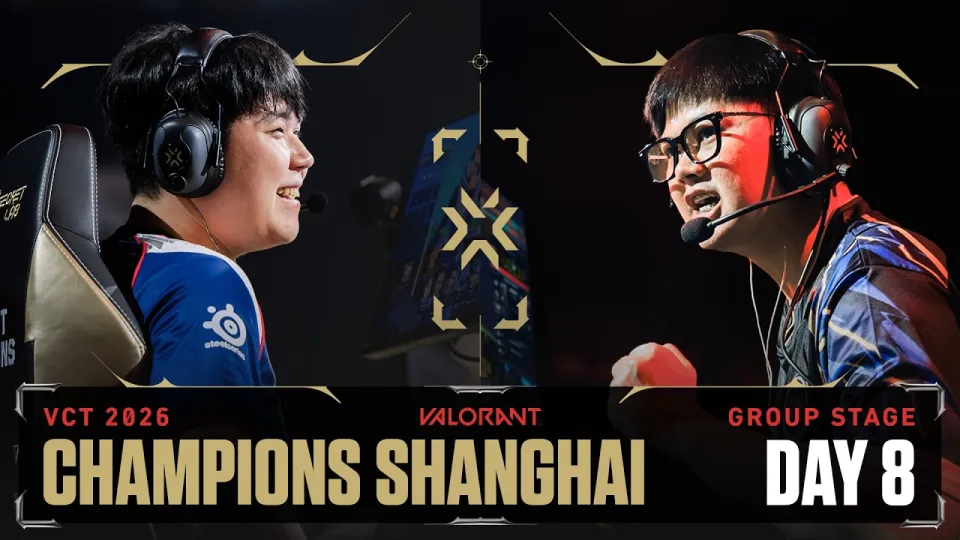
Video: VALORANT Champions Shanghai — Group Stage — Day 8
You can order the same kind of articles for your own video to boost it on YouTube and Google. Just message the Telegram bot @sat_sit_bot. It writes articles around your video, embeds the video and publishes them on popular niche websites (no ads). Your first 50 articles are free.
· based on the channel VALORANT Champions Tour
The best starting point for anyone searching for valorant at Champions Shanghai is the Day 8 group stage broadcast, because it contains the single most consequential series of the opening phase: T1 versus JD Gaming, a three-map elimination match that decided whether the host region would survive the group stage. Watch that series first, then work backward through the earlier match on the same day if you want context on how the bracket shaped up. Follow the official VALORANT Esports account on X for schedules, bracket updates and live results as the playoff picture settles.
Why Day 8 mattered more than any other group stage day
Day 8 carried the weight of the entire group stage because it was the last realistic chance for the Chinese representatives to stay alive on home soil. Sixteen teams from the Americas, CN, EMEA and Pacific arrived in Shanghai for a tournament running from September 24 to October 18, and by the end of this broadcast the CN contingent had been wiped out entirely. That outcome turned a routine group stage day into the story of the event: the region hosting the biggest trophy of the year could not keep a single team in the running.
The structure of the day was simple but brutal. Two series, each capable of ending a season, with the second one carrying direct elimination stakes. For neutral viewers the earlier match provided the mechanical highlights; for anyone tracking regional narratives, the later match was the one that mattered.
T1 vs JD Gaming was the series that defined the day
T1 versus JD Gaming is the match to study if you only have time for one, because it compressed an entire tournament narrative into three maps. JD Gaming opened with genuine ambition and built a 6-11 lead on the first map, a position that would have been an unprecedented result for a Chinese team against a Pacific heavyweight on the global stage. They did not close it. T1 clawed the map back, took the series, and JD Gaming's third map collapsed entirely, which is why so many viewers walked away convinced the opportunity had been thrown rather than lost.
The takeaway is not that JD Gaming lacked individual quality. It is that closing maps against established international opposition requires a different kind of composure than building leads, and that gap is exactly what separates a group stage exit from a playoff run.
- Map one: JD Gaming led 11-6, then lost the map.
- Map two: T1 extended control and forced the decider.
- Map three: JD Gaming fell apart, ending the series and the CN run.
The Crown silence and other moments viewers kept replaying
The most replayed moment of the broadcast had nothing to do with a clutch frag: it was the Crown being silenced, an ability interaction that viewers described as the most satisfying thing in the entire match. That kind of detail matters because it shows how much of modern VALORANT is decided by utility denial rather than raw aim, and it is a useful clip to study if you are learning how to neutralise a site anchor's ultimate.
Another clip that circulated widely was a disputed hit registration moment where three bullets appeared to connect with Omen but only two registered on the damage readout. Whatever the explanation, these moments are worth watching in the VOD at reduced speed if you want to understand how server-side hit confirmation and client-side feedback can diverge.
Tech pauses, learning lineups and the small stuff worth noticing
A tech pause interrupted the broadcast partway through the first series, and it lasted around a minute before play resumed. Technical stoppages are routine at international LAN events, but they matter for viewers because they reset momentum, and teams that handle the break well often come out sharper.
Beyond the pauses, Day 8 was unusually rich in small teaching moments:
- Players visibly testing lineup setups between rounds, which is a reminder that even professionals refine utility placement mid-series.
- A duelist assignment that confused viewers, with one player placed on a role the audience did not expect from them.
- Casters carrying long stretches of downtime with analysis, which is where the broadcast's real value sits for anyone trying to learn the game rather than just watch it.
If you are using the VOD to improve, watch the between-round segments rather than only the fights. That is where positioning and economy decisions become visible.
The regional question hanging over the group stage
The loudest debate around Day 8 was about regional strength, and it is worth addressing directly. The idea that hosting a Champions event creates a curse for the home region does not hold up: most teams perform better with crowd support, and the Chinese squads simply were not ready for the level of opposition they met. The more substantive criticism is structural, that automatic slots for the host region produced four teams that were eliminated without a single playoff appearance, and that a merged APAC qualification path might produce a stronger field.
Both things can be true at once. The slot allocation gave CN representation at its own world championship, and the results showed a clear competitive gap against the Americas, EMEA and Pacific rosters in Shanghai. How Riot balances regional representation against competitive depth is the real question the group stage raised.
Useful links
- Official VALORANT Esports updates: https://x.com/valorantesports
- Facebook: https://www.facebook.com/ValorantEsports/
- Instagram: https://www.instagram.com/valorantesports/
- TikTok: https://www.tiktok.com/@valorantesports
- Twitch channel: https://www.twitch.tv/valorant
What Day 8 tells us about the rest of Champions Shanghai
The group stage closer did more than eliminate teams; it set the tone for the playoffs. T1's comeback showed that Pacific rosters can absorb pressure and convert deficits, while JD Gaming's collapse confirmed that CN teams still struggle to close maps against top-tier international opposition. For viewers, the practical lesson is that the most instructive matches at this tournament are the ones where a lead changes hands, not the clean sweeps. The VALORANT Champions Tour channel produced this breakdown of Day 8, and its full broadcast remains the best resource for anyone who wants the complete picture rather than a highlight reel. Head to the official VALORANT Esports page on X to follow the bracket as the playoffs unfold.
Key takeaways
- Day 8 of the VALORANT Champions Shanghai group stage featured T1 vs JD Gaming across three maps.
- All four Chinese teams were eliminated from the tournament during the group stage.
- JD Gaming led 11-6 on map one before losing the series in a collapse viewers called a throw.
- A tech pause interrupted the broadcast and lasted roughly one minute.
- The full Day 8 broadcast runs over four hours and includes two complete series.
Questions & answers
Did any Chinese team make it out of the Champions Shanghai group stage?
No. All four CN representatives were eliminated during the group stage, which ended the host region's involvement before the playoffs. The final blow came on Day 8, when JD Gaming lost their series to T1 after holding a 6-11 lead on the opening map.
Why did JD Gaming lose map one after leading 11-6?
They failed to close out rounds once T1 stabilised their economy and started winning the utility exchanges. Viewers widely described it as a thrown map rather than a lost one, and the collapse carried into the third map, where JD Gaming were comprehensively outplayed.
What was the tech pause during the Day 8 broadcast?
A technical stoppage interrupted the first series and lasted roughly a minute before play resumed. Such pauses are common at international LAN events and typically reset momentum, which is why teams often look sharper immediately after the break.
Is the full Day 8 broadcast worth watching instead of highlights?
Yes, if you want to learn rather than just follow results. The broadcast runs over four hours and includes the between-round segments where economy decisions, lineup setups and role assignments become visible, none of which survive into a short highlight cut.
Source: VALORANT Champions Shanghai — Group Stage — Day 8 · Markdown version